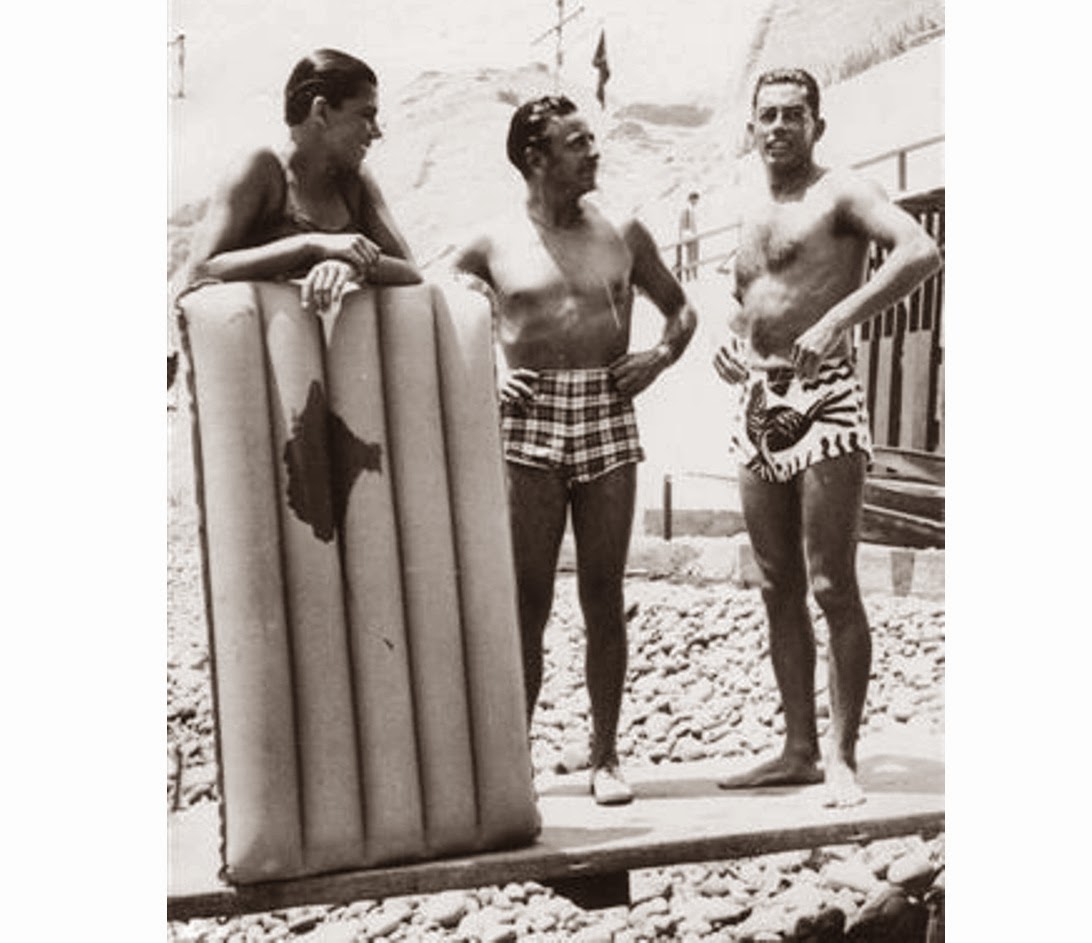
Given that even the most fundamental air mattress is a
pretty good wave rider, how did we get from here…
…to here?
And how was the Morey Boogie instrumental in the advancement
of mats and mat surfing?
The answer to those questions sounds like a beachfront zen
master’s response to the question, “How do you ride a surfmat?”
“You don’t. It rides itself.”
The evolution of mats was organic in the symbolic sense. Out of
sheer luck, the basic design of an inflatable, rectangular box of fabric surfed
pretty well. And because mats were fun for anyone to just play around with in the shorebreak, beach
concessionaires could make a modest return renting them to even the most casual beach goers.
At no point in the growth process of mat surfing was there any grand plan on the part of any
of the participants -- engineers, manufacturers, marketers, middlemen, or kids at the beach -- to make millions, rule the world, or prance around like the stud pony of Hermosa Beach. It was just a long, glorious series of coincidences that yielded the
most fun you can have in the ocean. (Did
I mention this is a subjective historical overview?)
Throughout the
decades, mat surfing has thrived as a sanctuary for the 10 year old child in
all of us. Surf mats resonate with the youngest beach goers...
...while still providing an unlimited cosmos of challenge to the most experienced
surfers .
Mat surfing can be a cradle-to-the-grave endeavor, but by the same token, it means little to anyone other than another mat surfer. We do it for ourselves, or we don’t do it at all.
Not much else in the modern world
can elevate us on the bubble of self discovery so effectively.
What makes the development of surfmat design so interesting
is that, from the 1930’s to the 1980’s, virtually none of the design work was
intended to advance the art of high-end mat surfing. Mats were
made in large quantity factory runs, and designs were only tweaked to either streamline production, or enhance durability
for use in the rough-and-tumble rental market. How well a mat
performed on a wave was of zero interest to a manufacturer in Wisconsin or
Taiwan or wherever.
If a mat rider wanted to wring more out of his/her mat,
they either had to accumulate a collection of mats and sort through them to
find a gem, or just keep surfing whatever was available and develop their riding
technique to suit. And in truth, most people liked it that way…otherwise, they
wouldn’t have been mat surfers in the first place!
It goes without saying that, in the ‘50’s, 60’s and 70’s,
George Greenough mastered both approaches. He found the best mats the world had
to offer...
...then rode them so well that he was able to push the existing limits
beyond anything other mat surfers could imagine.
What makes George’s genius at mat surfing so ironic, in
retrospect, is that it was taking place in the shadow of his stardom as the guru of the late 60's shortboard
revolution...
It would be like finding out that Jimi Hendrix transformed
the art of playing the bagpipes during his band's off hours. George’s brilliant mat riding had a dog whistle component to it…only a select few were able to
‘hear’ what he was saying while he was busy revolutionizing conventional
surfing. If all he’d ever done was ride mats, without the beach-cred of his radical kneeboard surfing to back it up, who
knows if he would have changed the course of our own history so dramatically.
Probably...but somehow it wouldn't have been the same.
So OK, mat surfing has existed since the 1930’s (in
Australia,) and flourished worldwide since the 1950’s. All mats were “good”
because their design and construction was inherently well suited to riding
waves.
Converse-Hodgman, in addition to their famed rubber-ended rental mats,
was turning out some really nice all-canvas inflatables during those years. Clearly, they weren't intended for use as hard core surf mats...
...but in the hands of matters like George, those soggy, red-white-and-blue beasts could fly.
A key
moment, for us, came in the early 1960’s when George realized that as his canvas mats ‘broke
in’ and got softer from constant use, they became noticeably faster. That was the
‘ah-ha’ moment that was the tipping point, in terms of
mat performance. But it took 20 years for that bit of knowledge to kick into high
gear.
Here’s how it happened…
By the late 1960’s, we were happy idiots, riding mats in
the relatively uncrowded junk days along the California coast….point breaks preferred,
but not necessary. The Converse Hodgman mats were George’s weapon of choice, so
that was all the rest of us needed to know. Our car trunks looked like a mobile
warehouse for the Hodgman factory. While a bit stiff and heavy, Hodgmans were
well made…so they could be ridden long enough (for years in most cases) that they
would soften up and perform well without much worry of a failure in the water.
(The lighter dime store cheapies went well right out of the polyethylene bag,
but lasted 1 or 2 go outs, tops.)
If you had asked any one of us if having Hodgmans readily available at the local sporting good store
for $50 bucks would be
agreeable for the rest of our lives, we would've all screamed “yes!”
But -- as with all good things -- something else came along and, seemingly, screwed it up.
In the summer of 1971, former surfboard manufacturer and aftermarket product wiz Tom Morey came back from a stint in Hawaii with a flexible ethafoam bellyboard in tow. The concept wasn't his idea, but the idea to build these body boards in quantity and market them in a professional manner certainly was.

Tom's
plan, he said to anyone who would listen, was to revolutionize surfing with the semi-solid flexy flyer he
called a Boogie. What seemed like a laughable intention at the time turned out to be
nothing short of a game changer. The silly, funky, improbable innocence of mat surfing was crushed by
the infinitely more pragmatic Morey Boogie. Beach rental shops quit carrying
mats…because Boogies were more durable. Young kids were now being weaned on
Boogies rather than mats…because Boogies were what were being rented. And so on
and so forth. It was a viscous cycle from the perspective of a mat surfer. The body board crowd even cribbed our favorite word -- fun -- and started promoting Boogie surf contests under the euphemism, "fun-test".
Converse Hodgman, who boasted many other, far more profitable
outdoorsy products, dropped surf mats from their line by the mid-70’s.
The writing was on the wall, and the world’s mat
surfers tried to eek every last go-out from their threadbare stash of Hodgmans...
...while
looking around for another standard bearer, mat-wise.
When the Morey Boogie displaced the Converse Hodgman, it generated what amounted to mat surfing's own "transition era," which was roughly 1978 through 1984. It was a painful journey that kicked us out of our comfort zone, but the rewards were beyond even George's imagination.
More to come...


 Hoping all's well!