Showing posts sorted by relevance for query "30 years of testing and tinkering". Sort by date Show all posts

May 4, 2014

30 Years of Testing and Tinkering: The Dimension Paradox


No, "The Dimension Paradox" isn't an episode of Dr. Who!  But Sci-Fi television frequently bases a story around some kind of threat from a parallel universe, where nothing is what it seems.

I often rely on the well-worn platitude that “nothing is what it seems” to deflect questions about the dimensions of surfmats. And for good reason. Mats are virtually impossible to measure in a manner we are accustomed to here on earth.
I know, I know...this flies in the face of the praise I heaped on mat building in Part #1 of my treatise, “Thirty Years Of Testing And Tinkering.” In it, I said:   

“In spite of the fact that mats are made up of curved tubes when inflated, the “build parts” are all straight, square, and thus easily calibrated. And while it’s virtually impossible to handshape two identical surfboards, it’s relatively easy to build two identical mats. All the parts can be marked out in the style of a draftsman, then assembled and welded with great consistency.”
Every word of that is true…but the twist is this: the instant a new mat gets welded up, those “precise” dimensions shrink a bit as the welds cure. Then, after that mat is surfed and goes through a few wet-dry-wet-dry cycles, those numbers shrink once again.

Conversely, and paradoxically, when the mat gets re-wetted out in the water, the dimensions loosen up, but not as far as the original build layout. They land somewhere in the middle. By the time a mat is used 3 or 4 times, none of the length/width/thickness numbers match up to what they were when the mat was originally built! But they are indeed proper, because when a prototype is built that works well, I can easily replicate it in future mats. What the exact numbers are on a finished mat don't matter. What matters is what numbers I use when I build the mat, and how that mat subsequently works in the water.

All this is fine from my perspective, as a builder. But from your perspective as a mat rider, it can be frustrating. Surfers often ask me how long or wide or thick a certain model is, and I can’t/won’t answer because the dimensions I go by – the numbers used in the initial construction – don’t exist in terms of the finished mat. At no point in its life will a mat calibrate, dimension-wise, with the original build numbers.

The most common dustup resulting from this confusion is when someone gets a backup mat for a model that they’ve been riding. They lay the new one over the old one, and say, “My new mat is longer than my old mat!” Well, both mats were made from the same material, and laid out with the identical set of build templates. The difference is the result of the older mat’s aging process. The well-used, broken in mat is “correct.” And the new one will be there after a week or two of use.
Another dimension-related dilemma is when an experienced prone surfer, who hasn’t ridden modern mats, asks for a mat of a specific length and width. They usually have a favorite paipo or alaia or bellyboard with those numbers. Seasoned mat riders know that there is no correlation between the dimensions of a good belly board and a good mat. This is in part because mats are so thick/light/buoyant, in part because they are so flexible, in part because they have no fins, in part because mats are parallel and have no outline shape, and in part because mats aren’t ridden fully inflated…so who’s to say how wide or long they really are when in use? 


I hate pulling out the “I know more about this than you do” line with new mat surfers, but I have to now and then.

It’s worth pointing out that a big part of the charm of mat surfing – that mats are pliable both literally as well as figuratively – contradicts the dimension-based wisdom of conventional surf craft design. In effect, mats are in conflict with the natural desire for surfers to understand the equipment they ride on a numerical level. It reminds me of the classic real estate anecdote about the man who asks the square footage of a property, while the woman just walks and around the place and takes it all in. When it comes to mats, just take it all in!

May 19, 2014

30 Years of Testing and Tinkering #4: The Law of Dynamic Positives: Part 1


Engineering professors love to say, with cynical glee, “If something can go wrong, it will.”
“Murphy’s Law” is the generally accepted name for this assumption. But, in fact, the above quote is properly referred to as “Finagle’s Law of Dynamic Negatives.”  (Google it!)
So what does Finagle’s Law have to do with us, the elite mat surfing community?
Well, nothing…because there are a good number of random events in the history of surfmat engineering that fall into the category of, “If anything can go right, it will.”
Mat design, as it turns out, is “right” most of the time. While it’s hard to build a really great mat, making a serviceable one is pretty darn easy. And that's why mat surfing was able to flourish as smashing good fun for the first half-century of its existence….say from the mid 1930’s to mid 1980’s.
Like most delightful things in life, the reason behind this is simple.
The ideal configuration to move through the water is a parallel-shaped object with an approximate length-to-width aspect ratio of 2:1. And, lo and behold, inflated tubes lashed together tend to be parallel. Further, the original mat dimensions  were designed to fit the length and width of the average kid's torso…roughly a 2:1 aspect ratio. So, without even knowing why, mat design was on the right track from Day One. The first mats ever made, way back in the 30’s, would be perfectly fun to ride today.

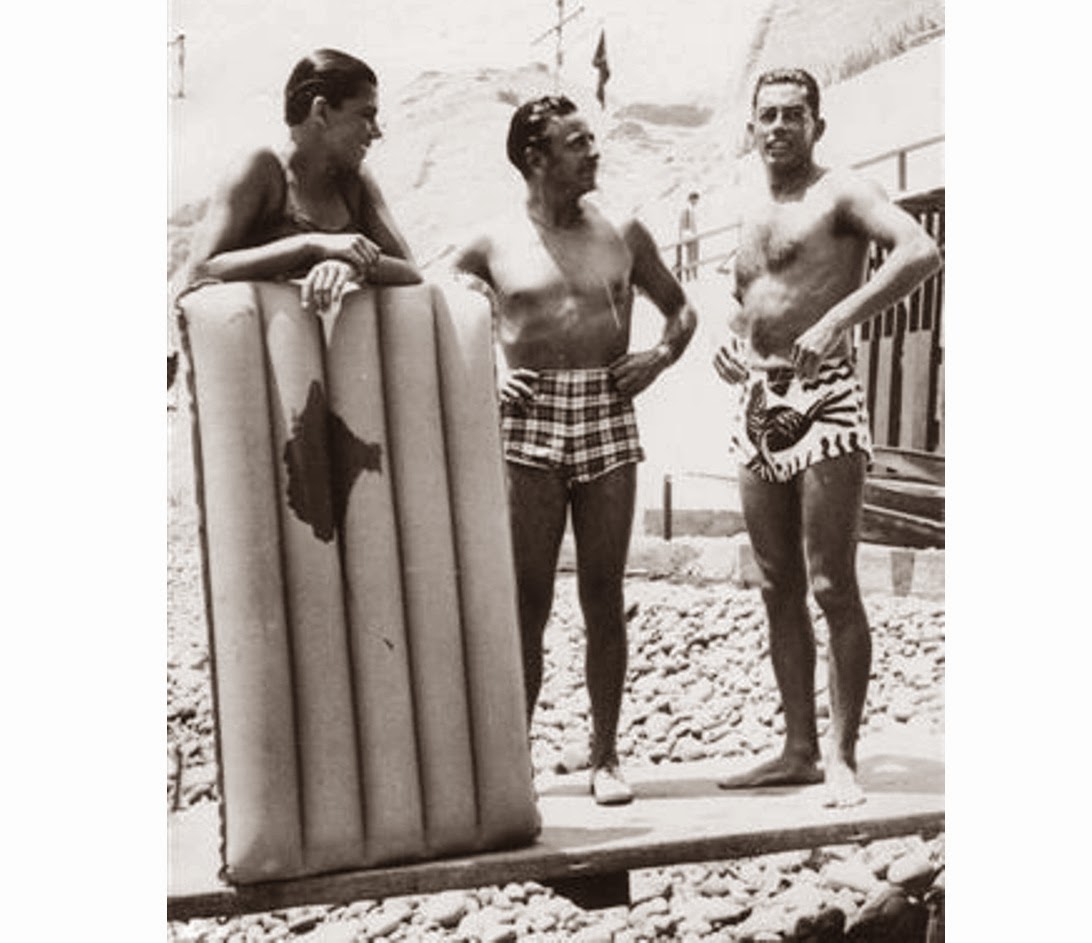
Bondi Beach, Mid 1930's
 
The downside of all this cosmic bliss is that, because other forms of surf craft have evolved so dramatically over the years, it’s natural for surfers to imagine how those same “advancements” might be applied to surfmats. And so, about twice a week, someone sends me an email and asks about trying a surf mat with an outline shape. Some think they should be curved like a surfboard…with a narrower nose and tail. Others go the opposite way, and want to use a concave outline shape, with the outline template generating a wider nose and tail, with a skinnier mid-section.
Please don’t misunderstand me, these are perfectly reasonable ideas. George and I have tried them all…or enough of them to realize that tweaking the outline shape of a surfmat not only doesn’t improve the performance, but actually degrades it.
But why?
There are two main reasons, from I’ve observed. One is that when you cut into the straight outer perimeter weld with either a concave or convex curve, not only is the outline changed, but the thickness flow changes as well. Pull the tail in with an outline curve, and the thickness flow of the outer pontoon in the tail thins out at the same time. So you lose the “hold” of the thick rail line. And that’s a serious drawback.
The “undercut” mats (narrower in the middle) work much better than the surfboard-shaped mats…but a mid-section that’s narrower is also thinner, so the noses tend to catch a lot. And the thinner middle drifts around at odd times.
 Example of a severely undercut mat.
 
 
The other downside of a surfboard shape on mats is that the outline curve tends to kick the mat out of its track. Mats need a straight outline and straight thickness flow to keep them moving in a straight line. Essentially, outline curves want to destabilize the mat. And since mats have no fin to rely on, straightness wins the prize when it comes to forward projection. 
Here’s a surfboard design anecdote from the 90’s that relates …
Back in the 90’s, Spencer Kellogg and I started shaping full length Simmons boards (9’ plus). We both assumed that the original Simmons boards, with their enormous tail width, were woefully underfinned. So we dropped a fin box into the first one and stuffed a longboard fin into it, confident we knew what we were doing.  Well, that first Simmons board, with a big fin, tracked in a straight line so badly we even couldn't paddle it without falling off the side of the board! It turned out that a small fin was the right call after all…which was what Simmons had figured out in the late 40s.

One of our Simmons boards -- a 10'4'' x 24" for Roger Kelly -- with a fin box allowing for experimentation. A relatively small Greenough Stage 4 fin worked best, even in Island surf!
 
The conclusion Spence and I drew was that outline curve, not tail width, determined how much fin a conventional surfboard needs. A straight outlined board, like a Simmons, needs less fin area, even though it has a wide tail. A curvy outlined board, like a thruster, needs a lot of fin area, even though it has a relatively narrow tail.
To further make that point, here's a quick evolution of outline shapes, relative to fin area...
 30's era plank. Very wide tail, dead straight tail outline, surfs OK with no fin.


 Restored early 50's Simmons board. Wide tail, slight outline curve, works best with a small fin.


Mid-50's era Velzy Pig.  Narrower tail with lots of outline curve, much bigger fin.


Early 80's Simon Anderson Thruster. Narrow, very curvy, needs lots of fin area.
 
To review:
 
  • The ideal surf craft, in terms of moving efficiently through the water, is a parallel shape with an aspect ratio of around 2:1.
  • A surf craft with a perfectly straight, parallel outline needs little or no fin area to surf well.
  • Mats naturally fit both criteria.

What makes this favorable outcome so cool is that it came about by engineering circumstance, not design intention! 

Maybe we should call that phenomenon,  "Mat Surfing's Law of Dynamic Positives."

Jun 2, 2014

30 Years of Testing and Tinkering #6: Boogie Days


Given that even the most fundamental air mattress is a pretty good wave rider, how did we get from here…

…to here?

And how was the Morey Boogie instrumental in the advancement of mats and mat surfing?
 
 
The answer to those questions sounds like a beachfront zen master’s response to the question, “How do you ride a surfmat?”
“You don’t. It rides itself.” 

  
The evolution of mats was organic in the symbolic sense. Out of sheer luck, the basic design of an inflatable, rectangular box of fabric surfed pretty well. And because mats were fun for anyone to just play around with in the shorebreak, beach concessionaires could make a modest return renting them to even the most casual beach goers. At no point in the growth process of mat surfing was there any grand plan on the part of any of the participants -- engineers, manufacturers, marketers, middlemen, or kids at the beach -- to make millions, rule the world, or prance around like the stud pony of Hermosa Beach. It was just a long, glorious series of coincidences that yielded the most fun you can have in the ocean.  (Did I mention this is a subjective historical overview?)
Throughout the decades, mat surfing has thrived as a sanctuary for the 10 year old child in all of us. Surf mats resonate with the youngest beach goers...


...while still providing an unlimited cosmos of challenge to the most experienced surfers . 


Mat surfing can be a cradle-to-the-grave endeavor, but by the same token, it means little to anyone other than another mat surfer. We do it for ourselves, or we don’t do it at all.  Not much else in the modern world can elevate us on the bubble of self discovery so effectively.

What makes the development of surfmat design so interesting is that, from the 1930’s to the 1980’s, virtually none of the design work was intended to advance the art of high-end mat surfing. Mats were made in large quantity factory runs, and designs were only tweaked to either streamline production, or enhance durability for use in the rough-and-tumble rental market. How well a mat performed on a wave was of zero interest to a manufacturer in Wisconsin or Taiwan or wherever.

If a mat rider wanted to wring more out of his/her mat, they either had to accumulate a collection of mats and sort through them to find a gem, or just keep surfing whatever was available and develop their riding technique to suit. And in truth, most people liked it that way…otherwise, they wouldn’t have been mat surfers in the first place!
It goes without saying that, in the ‘50’s, 60’s and 70’s, George Greenough mastered both approaches. He found the best mats the world had to offer...


...then rode them so well that he was able to push the existing limits beyond anything other mat surfers could imagine.


What makes George’s genius at mat surfing so ironic, in retrospect, is that it was taking place in the shadow of his stardom as the guru of the late 60's shortboard revolution...   


It would be like finding out that Jimi Hendrix transformed the art of playing the bagpipes during his band's off hours. George’s brilliant mat riding had a dog whistle component to it…only a select few were able to ‘hear’ what he was saying while he was busy revolutionizing conventional surfing. If all he’d ever done was ride mats, without the beach-cred of his radical kneeboard surfing to back it up, who knows if he would have changed the course of our own history so dramatically. Probably...but somehow it wouldn't have been the same.
So OK, mat surfing has existed since the 1930’s (in Australia,) and flourished worldwide since the 1950’s. All mats were “good” because their design and construction was inherently well suited to riding waves.

Converse-Hodgman, in addition to their famed rubber-ended rental mats, was turning out some really nice all-canvas inflatables during those years. Clearly, they weren't intended for use as hard core surf mats...
  
...but in the hands of matters like George, those soggy, red-white-and-blue beasts could fly.
 
A key moment, for us, came in the early 1960’s when George realized that as his canvas mats ‘broke in’ and got softer from constant use, they became noticeably faster. That was the ‘ah-ha’ moment that was the tipping point, in terms of mat performance. But it took 20 years for that bit of knowledge to kick into high gear.
Here’s how it happened…

By the late 1960’s, we were happy idiots, riding mats in the relatively uncrowded junk days along the California coast….point breaks preferred, but not necessary. The Converse Hodgman mats were George’s weapon of choice, so that was all the rest of us needed to know. Our car trunks looked like a mobile warehouse for the Hodgman factory.  While a bit stiff and heavy, Hodgmans were well made…so they could be ridden long enough (for years in most cases) that they would soften up and perform well without much worry of a failure in the water. (The lighter dime store cheapies went well right out of the polyethylene bag, but lasted 1 or 2 go outs, tops.)

If you had asked any one of us if having Hodgmans readily available at the local sporting good store for $50 bucks would be agreeable for the rest of our lives, we would've all screamed “yes!”

But -- as with all good things -- something else came along and, seemingly, screwed it up.


In the summer of 1971, former surfboard manufacturer and aftermarket product wiz Tom Morey came back from a stint in Hawaii with a flexible ethafoam bellyboard in tow. The concept wasn't his idea, but the idea to build these body boards in quantity and market them in a professional manner certainly was.

Tom's plan, he said to anyone who would listen, was to revolutionize surfing with the semi-solid flexy flyer he called a Boogie. What seemed like a laughable intention at the time turned out to be nothing short of a game changer. The silly, funky, improbable innocence of mat surfing was crushed by the infinitely more pragmatic Morey Boogie. Beach rental shops quit carrying mats…because Boogies were more durable. Young kids were now being weaned on Boogies rather than mats…because Boogies were what were being rented. And so on and so forth. It was a viscous cycle from the perspective of a mat surfer. The body board crowd even cribbed our favorite word -- fun -- and started promoting Boogie surf contests under the euphemism, "fun-test".
Converse Hodgman, who boasted many other, far more profitable outdoorsy products, dropped surf mats from their line by the mid-70’s.

The writing was on the wall, and the world’s mat surfers tried to eek every last go-out from their threadbare stash of Hodgmans...

...while looking around for another standard bearer, mat-wise.
When the Morey Boogie displaced the Converse Hodgman, it generated what amounted to mat surfing's own "transition era," which was roughly 1978 through 1984. It was a painful journey that kicked us out of our comfort zone, but the rewards were beyond even George's imagination.

More to come...


Jun 15, 2014

30 Years of Testing and Tinkering #7: The Slow Leak Revolution: Part 1

With great fanfare, conventional board surfing experienced a transformation during the late 60's that shook its framework to the ground. Surfers referred to it as "The Transition Era," while the surf media dubbed it, "The Shortboard Revolution."

In either case, the classic "too big to fail" longboard labels like Webber, Hobie, Greg Noll, and Gordon & Smith were upended to the degree that they were never able to fully recovered their former glory. The emergence of the shortboard era -- in the form of smaller surfboards and a fresh attitude -- was that powerful.

Nat Young kicked off the whole mess, winning the World Surfing Contest in the fall of 1966 on a blade-thin 9'4'' he named Magic Sam...


Sam was short by the standards of the day (10' plus noseriders were commonplace), and it featured a narrow, flexible fin designed and constructed by George Greenough. That fin was a key to Sam's performance...perhaps even more so than its shorter length and lean thickness profile.
 
Nat Young's convincing win in the World Contest jump-started a mega-shift in surfing. Attitudes changed, and boards began dropping in length. From 10 foot long beach party props in the early 60's...


...to sub-7 foot mind machines by the early 1970's.


Shorter-than-usual surf crafts have been ridden throughout surfing's history...


...but Nat Young's dominance in the mainstream arena of contest surfing...


...combined with Greenough's outside-the-box boards and surfing, resonated with surfers of every social perspective.


Calling the shortboard transition era a "revolution" sounds cheeky today, but if anything, it's an understatement. For those who weren't around back then, we went from seeing nothing in the water under 9'6'' long to seeing nothing over 8' long in 18 months. The change was so radical, surfers who were inclined to keep riding longboards were actually intimidated to do so. By the Woodstock summer of 1969, only San-O and Waikiki continued to embrace longboard surfing. Even First Point Malibu -- longboard heaven by any measure -- was filled with nothing but shortboards...aside from the occasional appearance by Lance Carson.

The mythology of the shortboard revolution has been expressed for years, but historians invariably assume that stand up surfing was, and is, a pinnacle of the surfing experience. The fact that the seminal character in the transformation from longboards to shortboards -- George Greenough -- was both a kneerider and surf matter is generally downplayed.

With all that in mind...

Mat surfing's own transition era -- from heavy cotton canvas rafts to new-age nylon rocket ships -- was also inspired by George Greenough. But we experienced a much slower change. George refers to it as "the slow leak revolution." That's a double entendre of sorts...referring to how long it took for the changes to take place, as well as how leaky mats (ridden softer by default) were one of his first clues that more pliable mats performed better.

As covered in posting #6, the emergence of the Morey Boogie broke the lineage of mat surfing by 1974, because Boogies provided a more practical alternative for the recreational beach goer. The reliable Converse Hodgman surf mats of the 60's and early 70's ceased production, and we were left riding our dwindling stash of Hodgmans...later followed by whatever else we could find in the market place.

During the post-Hodgman era (roughly 1978 onward) we had a choice between the ubiquitous dime store cheapy mats -- which tended to be too small in dimension and too short on durability -- or slightly better surf mats imported from Taiwan with an Australian surf corporation logo stenciled on the deck. Some of those imports had skegs and handles bonded onto them. Some even had crudely pointed noses as well.

Rip Curl and Merrin were the primary distributors of these mid-range quality mats, and by the fall of 1978, George started bringing suitcases filled with Merrins back to California when he returned from his annual stint in Australia.

We would carefully peel the handles and skeg off the mats....


...and transform them into "serious mats for serious mat surfers."

George's long-held belief that softer mats (either loosened up through repeated use, or ridden with low inflation, or both) were faster had been proven time and again. Without us knowing it, going all the way back to the 60's, that had been 'Phase 1' of the slow leak mat revolution.

'Phase 2' began to coalesce in 1978, when we would alternate between old, fully broken in Hodgmans and crisp new Merrins the same day in the water...and the Merrin would be faster because they were flimsier. Merrins turned out to be fun to ride, in many ways better than the more durable Hodgmans.

At that point, we had no idea what the limit was for a soft, pliable mat. All we knew was that Merrins had opened our eyes to the advantages of mat which was even more compliant than a broken-in Hodgman. But again, we had no idea how far we could take it.

Here's George running across a wall on a Merrin in Greg Huglin's classic film, Fantasea...


...and shooting footage off his back on that same yellow mat...


After a year or two of use, our first-gen Merrins became worn to the point of being threadbare...and, like a broken-in Hodgman, they went even faster! So broken-in Merrins became 'Phase 3' of the slow leak revolution.

One afternoon in the upper parking lot at Rincon, probably around 1980 or '81, Greenough floated the idea that maybe we should peel the fabric off the bottom of our tired Merrins, leaving just the thin rubber inner lining. Paul Masiel and I scoffed at the notion, assuring George that the bottom would explode before he even made it out through the shorebreak. And even if he did make it, there's no way something that radical would work on a wave.

George being George, he took that as a challenge. The three of us paddled out, and after we'd made it to calm water, George rolled off his mat and started tearing the fabric off the bottom. Paul and I looked at each other, rolling our eyes. George sensed our disapproval and said something like, "I don't care if my mat pops...all I need is one wave to tell us if this is a good idea!"

A little set rolled in (like, shoulder high) and George spun around and took the first wave. I caught a later wave in the set, and as I rode towards George, who was paddling back out, he had that steely-eyed stare that he gets when he's right about something, and wants you to know it. I pulled out of my wave, and he paddled up to me, slipped off his mat, shoved it towards me and barked, "Try this."

By dark that evening, all three of our Merrins had the bottom fabric peeled off.

The rubber bottomed mats were so pliable, they jumped gears without any input from the rider. We could set them in trim, the bottom would conform the wave face, and the mat would just keep accelerating. George started calling them "Peelers."

While the Peelers didn't pop after 5 minutes as we feared, they were extremely fragile because of their thin rubber bottoms...so it didn't take much to ruin one. If they touched the bottom when you were paddling out, it was over. If you rode too far up onto the sand coming into the beach, it was over. They weren't practical, but as George pointed out, "If we have to break out a new Merrin every other week, the performance is worth it!"

For all the shortcomings of the Peelers, they became 'Phase 4' of the slow leak revolution.

Our observation at that point was that every time we rode a thinner skinned mat, it worked better. We still didn't know what the lower limit would be...but thus far, the more flexible a mat's skin was, the more performance a rider could wring out of it.

--------------------------------------------------------------------------------

Epilog: If you look at this mat riding sequence in Fantasea, there's a bit of mat-transition history lurking in there...


The opening shot is of George and I carrying Merrins up the point. The wave I'm riding, right at the start, was the first wave I ever rode on a Merrin. You can see I'm a little tentative with the small size of the mat, and the slippery deck (compared to the coarser Hodgmans.) George had been riding his yellow Merrin for some time, and was totally tuned in. 

All but one of the shots in this clip are of us riding Merrins. The POV/backpack shot George took, at the 1:45 mark, is of me on a "Stripes Across" Hodgman. That shot was taken the day before the other shots were taken, and that was the last time I ever rode a Converse Hodgman in earnest. After I surfed my Merrin a few times and got the hang of it, I liked it better.

FWIW, the Merrins in this sequence weren't Peelers. George didn't come up with that idea for another couple of years.

It's hard to believe that the mat surfing shown in Fantasea is 35 years old...

May 26, 2014

30 Years of Testing and Tinkering #5: The Law of Dynamic Positives: Part 2


This is a continuation of last week’s rant about why so much of mat design -- mostly by dumb luck -- is well suited to riding waves. And not just suited to riding up to the shore on a foot high bit of white water...but also riding quality waves in a fast, “effective” manner.


Of the many "natural" elements of mat design, the round rail is the most misunderstood in the eyes of the average board rider. The fat, round rail shape is one of the reasons that even older, heavier, stiffer mats can attain such amazing speed. Yet that flies in the face of “conventional rail design wisdom.”  Most surfers today believe that low, edgy rails hold in better and are faster…while round rails are sluggish and slide out.

This is a pure round rail, with no fin, holding in and flying. Not on a small wave, either... 
 
...and a hard bottom turn with only the fat part of the inside/lower rail in the water. Flippers completely free of contact as well. Pure rail hold.
 
Misconceptions about round rails came about in the late 60’s, when stand up surfboards suddenly dropped in width from over 22” wide to under 19” wide…a huge difference. Experimental low rails accompanied that shift in thinking, and because the new narrow miniguns held in better, most people concluded that low rails were the reason why. In truth, it was the severe reduction in width that was providing the added hold that was so exciting to everyone at the time...but the myth that low rails were the deciding factor in this improvement persists to this day.
If you look at the footage of Dru Harrison (at the 8:30 mark) riding a narrow displacement hull in small Honolua Bay...


...you can plainly see Harrison's narrow hull held in as well as the narrow down railers being ridden at the same time. Because it was the width, not the rail shape, that did the "work."
Flat bottoms and low rails shear the water away from the board...which isn't a bad thing! Boards with low rails can skate and pivot around ‘at will’ because the board isn’t glued to the wall of the wave. Back in the 70’s, that lack of rail grip was compensated for by narrow boards with narrow tails. These days, tails have widened back up, proportionately. And, in the case of the ubiquitous thruster design, three fins are needed to give the rider command over the board without spinning out. It’s a combination of extremes – flat bottom, low rails, and a lot of fin area -- that obviously works well. But low rails DO NOT do the work of holding in. The fins do.
The finless boards prior to 1950 had round bottoms and rails, because "round" generates a severe low pressure area when water passes over it (or it passes over the water). And that low pressure area draws the rail into the wall of the wave. 


To observe this suction effect, try holding a soup spoon under a stream of running tap water, and feel the round side quickly draw into the moving water, while the concave side kicks away from the water.  

An interesting historical side-note is that the fin was first used by Tom Blake in the 1930’s to control the forward motion of his hollow wooden paddle boards...the same paddle boards that had box rails with an edge going around the entire bottom due to their construction. Fins and low rails were a copasetic pairing from day-one...because Blake's early "low rails" didn't hold in.


In the case of our surf mats, we have a round rail shape that's naturally generated by an inflated sheet of fabric. And, on top of that, we have a nifty little flange running around the perimeter – again, due to construction technique rather than the intent of the original designers. That flange shears water away from the top half of the rail in lower speed situations…a nice addition to an already good design package.


But wait, there’s more !!!

Mats also sport a flat rocker scheme, which is extremely fast, even on flat faced waves... 


And yet mats are also flexible enough, longitudinally, to allow the rocker to conform to the face of the wave...with a little help from the rider. These two shots, taken just a second or two apart, show how even an old heavy canvas mat can change rocker shape at will…


Easily controlled rocker also makes riding bumpy waves a new sport!


So we had the makings of a great wave riding vehicle already in place as the basic air mat was originally built....a parallel outline, flat rocker, no fin, round rails, a flange, and some nice flexural tendencies.


With so much going for mats straight out of the starting gate, where did we go from there? And why?  Highly subjective answers coming soon!